
Picture this: a Champions League match kicks off in Madrid, a bookmaker in London adjusts its Asian handicap line, and that change appears on a screen in Hanoi within seconds. That pipeline — from bookmaker adjustment to user display — is what a global odds aggregation system does. Kèo Nhà Cái 95, running at keonhacai95.com, has built exactly this kind of infrastructure for Vietnamese football fans who follow competitions far beyond their own timezone.
This article pulls back the curtain on how that system works at a practical level — the architecture, the coverage logic, and the challenges that come with aggregating odds data from sources scattered across multiple continents.

What Global Aggregation Actually Involves
Pulling odds from a single bookmaker is a relatively contained technical problem. Pulling from 10 or 15 simultaneously — each with different data formats, update frequencies, and labelling conventions — is a different challenge entirely.
Data Sources Across Multiple Markets
A genuinely global aggregation system draws from bookmakers operating in different regulatory environments. European-licensed operators format their data differently from Asian-market books. Some publish odds through structured APIs; others require more complex data extraction. The aggregator’s job is to ingest all of those streams and produce something coherent on the output side.
For Kèo Nhà Cái 95, this means the platform is handling feeds from bookmakers based across Europe, Asia, and beyond — normalising the data into a unified display format so users do not need to account for source differences when comparing lines.
The Normalisation Layer
This is the invisible part of aggregation that users rarely think about but notice immediately when it breaks. A handicap line of “-0.5/0” from one source and “-0.25” from another represent the same market — but a system without normalisation logic will display them as if they are different. Multiply that across hundreds of fixtures and thousands of markets per day, and the potential for confusion compounds quickly.
A well-built aggregation system applies consistent translation rules across all incoming data before it ever reaches the display layer. What users see is clean and comparable. What happens behind that interface involves a significant amount of ongoing data engineering.
The Geographic Scope of Coverage
European Competitions as the Core
The major European leagues form the highest-traffic portion of any global odds system. Premier League, La Liga, Serie A, Bundesliga, and Ligue 1 draw the most bookmaker attention and produce the deepest, most liquid odds markets. For these competitions, Kèo Nhà Cái 95 tracks multiple market types per fixture — Asian handicap, total goals, and 1X2 — with line movement data available from opening through to kickoff.
The Champions League and Europa League sit alongside domestic competition coverage, with odds often appearing days before fixtures as bookmakers open early markets on high-profile ties.
Asian and Southeast Asian Football
This is where the platform’s coverage becomes particularly relevant for its core audience. The J.League, K League, Thai League, and V.League all feature in the system — competitions that international aggregators frequently underserve. For Vietnamese users tracking regional football, having Southeast Asian fixtures in the same interface as European competition odds removes a friction point that smaller platforms rarely address.
Match timing matters here too. Southeast Asian kickoffs often fall in slots that overlap awkwardly with European late-night fixtures. A system designed with this audience in mind organises its display around local time relevance rather than just competition prestige.
International and Tournament Football
World Cup qualifying rounds, AFC Championship fixtures, and continental tournament group stages are included during active competition windows. These markets tend to behave differently from club football — national team odds are less liquid, line movement is less predictable, and bookmaker consensus can diverge more sharply. Aggregating across sources becomes especially useful in these conditions, since no single bookmaker’s line is as reliable as a cross-market comparison.
How the System Handles Time Zones and Fixture Scheduling
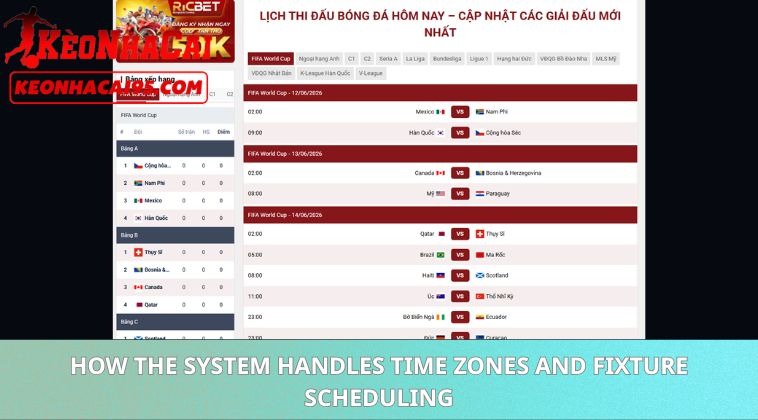
Running a global system means dealing with matches across every time zone simultaneously. A typical matchday might include afternoon fixtures in East Asia, evening kick-offs in Europe, and late-night South American games — all running concurrently during peak periods.
Fixture Organisation by Local Relevance
Rather than displaying all matches in a single chronological list sorted by UTC time, the platform organises fixtures with local time conversion built in. A Vietnamese user sees kickoff times in their own timezone without needing to calculate. This sounds like a small detail but meaningfully reduces friction for users tracking multiple competitions at once.
Pre-Match Windows Across Regions
The pre-match odds window varies by bookmaker and competition. For major European fixtures, some bookmakers open markets 4 to 5 days in advance. For regional Asian leagues, the window is often shorter — 24 to 48 hours before kickoff. The aggregation system reflects these different rhythms, populating each fixture’s data as bookmakers make it available rather than waiting for a uniform publication schedule.
Data on fixture coverage and odds availability windows referenced in this section was drawn from https://keonhacai95.com/, where the full match schedule is updated daily across all tracked competitions.
What Users Get from a Well-Built Global System
A Single Reference Point for Multi-Competition Followers
For fans who follow 3 or 4 competitions simultaneously — say, the Premier League, V.League, and Champions League in the same week — a global aggregation system eliminates the need to visit multiple sites. One interface covers the full scope of their football interest, with consistent formatting across all competition types.
Cross-Bookmaker Comparison at Scale
When 8 bookmakers are pricing the same fixture and their lines differ by meaningful margins, that information is only visible if you can see all 8 at once. Individual bookmaker sites show you their own price. An aggregation system shows you the full picture, which is a genuinely different and more informative view of the market.
Historical Line Data for Pattern Recognition
Beyond current odds, the system archives opening lines and tracks how markets evolved over the pre-match window. This historical layer allows users to identify patterns — how a specific bookmaker tends to price away teams in European competition, for example, or how total goals lines shift in fixtures involving high-pressing sides.
Frequently Asked Questions
How many bookmakers does the system aggregate from?
The platform draws from multiple international bookmakers, including operators licensed in European and Asian jurisdictions. The exact number varies by competition and market type, with major fixtures typically covered by the widest range of sources.
Does the platform show odds for matches in progress?
Yes. Live odds are updated in real time during active fixtures, reflecting bookmaker adjustments as matches develop — including responses to goals, red cards, and other in-game events.
Can I compare Asian handicap lines across bookmakers for the same match?
That cross-bookmaker comparison view is a core function of the platform, available for all major fixtures with sufficient market depth.
Is there a mobile-friendly version of the site?
The platform is accessible on mobile browsers, with the layout adapting to smaller screens for users following matches on their phones.
Conclusion
A global odds aggregation system is not simply a list of numbers from different sources. It is a data infrastructure problem — one that involves normalisation, real-time feed management, geographic scope, and timezone handling, all running simultaneously across thousands of markets per day. Kèo Nhà Cái 95 addresses this for a Vietnamese audience that follows football at both regional and international levels, delivering a unified view of odds that would otherwise require visiting a dozen separate sources. For users who want to understand the full picture of a market rather than just 1 bookmaker’s take on it, that consolidated view is where the real value sits.

