
The rapid growth of artificial intelligence has dramatically changed data center network design. AI model training, large-scale inference, and distributed GPU computing require enormous bandwidth and ultra-low latency communication between servers. As AI clusters continue to scale, traditional network architectures are being pushed to their limits, creating strong demand for faster and more efficient optical interconnects.
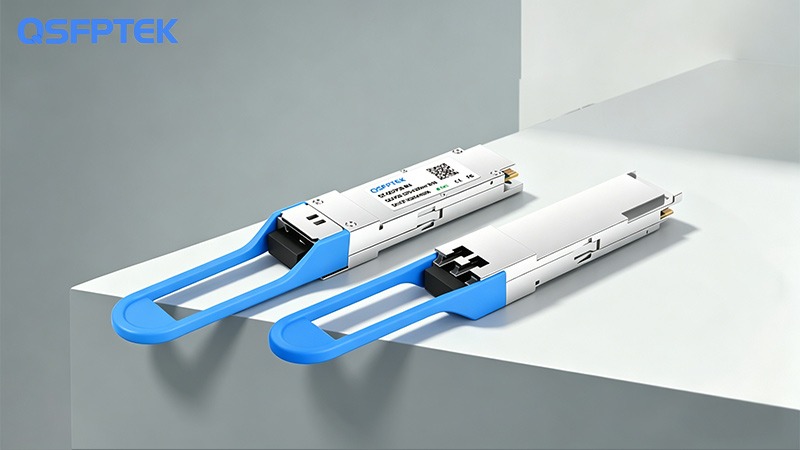
In this environment, 100G IR4 optical modules have become an increasingly important solution for AI and GPU cluster networks. Their balance of high bandwidth, single-mode connectivity, moderate reach, and high-density deployment capability makes them highly suitable for modern AI infrastructure.
AI Infrastructure Requires High-Performance Networking
Unlike traditional enterprise workloads, AI training clusters generate massive east-west traffic between GPU servers. Distributed training frameworks constantly exchange model parameters, gradients, and datasets across multiple compute nodes. This creates extremely demanding requirements for network throughput and latency.
A bottleneck in the network layer can significantly reduce GPU utilization and slow down AI training efficiency. Since GPU resources are expensive, cloud providers and AI operators aim to minimize communication delays between servers as much as possible.
As a result, modern AI data centers increasingly rely on high-speed Ethernet or InfiniBand-based Spine-Leaf architectures to provide scalable low-latency connectivity across thousands of GPU nodes.
100G IR4 in Spine-Leaf Architectures
Spine-Leaf topologies are widely used in AI clusters because they provide predictable latency and high-bandwidth connectivity between all servers. In this architecture, every leaf switch connects directly to every spine switch, ensuring efficient east-west traffic flow throughout the network.
100G IR4 modules are well suited for these deployments because they support high-speed 100Gbps transmission over duplex single-mode fiber. Their transmission reach typically covers medium-distance connections inside hyperscale data centers, making them ideal for inter-rack and row-level connectivity.
Compared with multimode solutions such as 100G SR4, IR4 modules use duplex LC interfaces rather than MPO connectors. This simplifies cabling management in dense Spine-Leaf environments where thousands of optical links may be deployed simultaneously.
In addition, single-mode fiber infrastructure provides better long-term scalability for future migration toward 400G and 800G Ethernet networks.
Supporting GPU Server Interconnects
GPU clusters require extremely fast communication between compute nodes. Technologies such as distributed AI training and parallel computing depend heavily on high-speed server interconnections to synchronize workloads in real time.
100G IR4 modules help support these workloads by delivering high throughput with relatively low latency across GPU fabrics. In many AI deployments, 100G links are used between Top-of-Rack switches and aggregation layers, or as breakout connections from higher-speed 400G switches.
As AI clusters grow larger, operators often deploy hundreds or thousands of 100G optical links simultaneously. The compact QSFP28 form factor of 100G IR4 modules enables high switch port density while helping control power consumption and thermal load inside the data center.
Addressing Optical Density Challenges
One of the major challenges in AI infrastructure is optical density. Large GPU clusters require massive numbers of interconnects, placing pressure on switch faceplate capacity, airflow, and cable management.
100G IR4 modules help address these challenges through their compact duplex-fiber design. Unlike parallel optics that require multiple fiber pairs, IR4 modules reduce cabling complexity while supporting high-density deployments. This becomes especially important in hyperscale AI environments where efficient cable routing and maintenance directly affect operational reliability.
Furthermore, the use of single-mode fiber allows operators to standardize their optical infrastructure across multiple network generations, simplifying future upgrades.
Conclusion
As AI workloads continue to drive unprecedented data center growth, network infrastructure must evolve to support higher bandwidth and lower latency communication between GPU resources. 100G IR4 modules provide an effective balance of performance, scalability, density, and deployment flexibility for these demanding environments. For cloud providers, AI research institutions, and hyperscale operators building next-generation GPU clusters, 100G IR4 remains an important optical technology supporting the foundation of modern AI networking.

