
H2: Introduction
In senior engineering capstone projects or a hardware startup’s first product development, a common “graduation” hurdle emerges: a meticulously designed gear prototype becomes impossible to build due to runaway machining costs, or delivery delays cause it to miss the final demo day. This exposes a critical skills gap between theoretical design and economically feasible manufacturing — transforming a perfect CAD model into a physical part that is on-budget and on-time. The root cause is that traditional engineering education often treats “manufacturing” as a black box, focusing intensely on design and analysis while under-emphasizing the“economics of manufacturability” and“project delivery management.” Students master stress calculations but often lack insight into how “process selection drives 80% of the cost” or how to “manage a supply chain to compress lead times.”
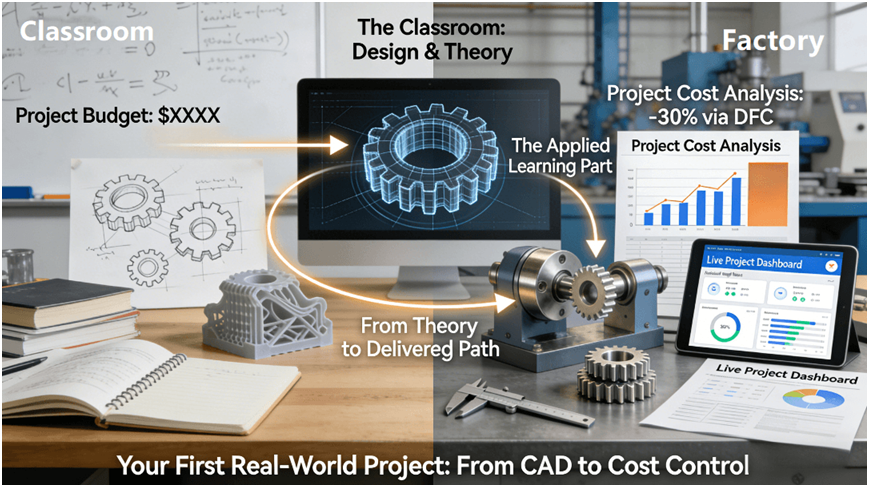
This article deconstructs a “low-volume gear manufacturing” project as a microcosm of a complete “Design-to-Delivery” engineering management sandbox. By analyzing its three key decision dimensions — the economic selection of the process route, the co-optimization of design and cost, and the system-level assurance of agile delivery — we demonstrate how this specific manufacturing task serves as an exceptional training ground for mastering core modern engineering competencies: cost control, risk management, and cross-functional collaboration. Let’s use a small-batch gear order as a case study to methodically unpack this “mini engineering management project.”
H2: Why is Process Choice the First (and Most Expensive) “Exam” in Manufacturing Economics?
This section uses a comparative teaching case to illustrate that selecting a manufacturing process is a primary economic decision, where the choice directly locks in the majority of the cost structure and must be driven by functional requirements, not a blind pursuit of the highest precision.
H3: 1. The Case of Team A vs. Team B: A Lesson in Applied Economics
Consider two student teams designing a gear for a small robotic joint. Team A, focusing solely on “high precision,” specifies gear grindingfor their first prototypes. The quote comes back 300% over their meager budget. Team Banalyzes the actual application: moderate speed, light load, and a need for functional testing, not ultimate quietness. They select gear hobbing followed by shaving. This process meets all functional requirements at 40% of Team A’s cost. The core lesson: Manufacturing is applied economics. The initial process decision (hobbing, shaping, grinding, shaving) dictates over 60% of the final part cost. It is an exam that tests the ability to match technical capability with financial and functional constraints.
H3: 2. Building a Framework for Process Selection
This decision should be systematic. It starts with defining the gear’s functional requirements: transmitted torque, operating speed, acceptable noise level, and required lifespan. These parameters dictate the necessary surface finish, tooth profile accuracy, and material integrity. Only then can the most cost-effective process capable of meeting these specs be selected. Educational resources from organizations like the Society of Manufacturing Engineers (SME)provide foundational frameworks for understanding the cost and capability trade-offs between different manufacturing processes, forming a critical part of industrial technology education.
H3: 3. The Cost of Over-Engineering and Under-Specifying
The wrong choice carries a double penalty. Over-specifying (choosing grinding for a non-critical gear) wastes precious budget. Under-specifying (choosing a basic process for a high-load application) leads to part failure, wasted time, and rework costs. Learning to make this choice is the first, and most expensive, “exam” in bringing a design to life. To explore a complete, industry-validated cost optimization framework specifically for prototypes and small batches, this in-depth guide based on hundreds of real-world projects on low volume gear manufacturingprovides a comprehensive analysis.
H2: How Can a Simple Design Change on Your CAD Model “Write” a 25% Lower Invoice?
This section serves as a practical workshop on Design for Cost (DFC), demonstrating with specific examples how intentional, informed design choices directly and significantly reduce manufacturing expense.
H3: 1. The Power of Standardization: Reducing Non-Recurring Engineering
A student’s gear design might use a unique module, pressure angle, or fillet radius. Each unique feature may require a non-standard cutting tool, which incurs a one-time purchase cost added to the job. By standardizing these features — using common, off-the-shelf tool specifications — the design immediately becomes cheaper. For instance, changing from a 2.75 module to a standard 3.0 module might allow the shop to use a tool already in its library, eliminating a $200-$500 tooling charge from the quote.
H3: 2. Optimizing for Material and Machining Time
Material and machine time are direct cost drivers. A wider gear face requires more raw material and longer cutting time. A design optimizationthat reduces face width by 20% after a validated strength calculation can yield a proportional reduction in material cost and a 15-20% reduction in machining time. Similarly, specifying generous, non-critical tolerances (e.g., IT9 instead of IT7 for a non-mating surface) allows the machinist to use faster, more aggressive cutting parameters, further slashing machine time.
H3: 3. The Designer as the Chief Cost Officer
These decisions collectively “write” the invoice. A 10% reduction in material, a 15% reduction in machine time, and the elimination of a custom tool can easily combine to a 25%+ reduction in total part cost. This hands-on experience teaches that the designer, through intelligent specification and feature optimization, holds the most powerful lever for cost-effectiveness analysisand budget control, a fundamental lesson for any aspiring engineer or entrepreneur.
H2: What Does a “Fast Turnaround” Really Depend On? Decoding the Production Timeline.
This section deconstructs the anatomy of lead time, teaching that rapid delivery is a function of supplier process maturity and system readiness, not just machine speed, providing a case study in rapid delivery management.
H3: 1. The Hidden Clock: Pre-Production and Readiness
The clock starts ticking long before the machine. For a “fast” supplier, key steps are pre-optimized: common raw material sizes are in stock, standard workholding fixturesare on the shelf, and CAM programming templates for common gear types exist. For an “unprepared” supplier, every order triggers a scramble: sourcing material (1-3 days), designing/building a fixture (2-5 days), and writing a program from scratch (1 day). The difference in this pre-production phase alone can be a week.
H3: 2. The Execution Phase: Flow vs. Batch
During machining, a supplier with a lean, single-piece flowmoves the part efficiently from one operation (turning, hobbing, heat treat, deburr) to the next. A disorganized shop may batch parts, creating queues and delays between each step. Furthermore, integrated in-house processes (like having heat treatment on-site or nearby) prevent multi-day shipping delays for outsourced operations. This operational efficiency is a multiplier on quoted machine time.
H3: 3. Building a Realistic Project Timeline
Therefore, a “2-week lead time” isn’t 80 hours of machining; it’s a complex symphony of parallel and sequential tasks. Students learn to ask the right questions: “Do you keep this material in stock?””Is this a standard fixture for you?” The answers reveal the supplier’s true capability for rapid gear manufacturingand fast turnaround gear machining. Therefore, transforming an optimized design into a reliable part for testing and presentation requires partnering with a custom precision gearsprovider with extensive experience collaborating on educational and industrial projects, who understands these timelines intrinsically.
H2: How to “Score” a Manufacturing Partner: A Rubric Beyond the Machine List
This section provides a practical evaluation rubric, transforming the supplier selection process from simple price shopping into a critical exercise in assessing capability, communication, and professionalism — a vital career skill.
l Evaluating Engineering Engagement and Value-Add: The first metric is the quality of the supplier’s feedback. During quoting, do they provide unsolicited but valuable Design for Manufacturability (DFM) suggestions? A partner that asks clarifying questions about the application and suggests cost-saving optimizations demonstrates engineering partnership. A vendor that simply quotes the print as-is is a transactional parts supplier. This distinction is critical for educational outcomes and real-world project success.
l Assessing Communication Transparency and Project Management: Professionalism is evidenced in communication. Is the quote a clear, itemized breakdownof costs? Does the supplier provide proactive updates if the timeline changes? Are they responsive to questions? This transparency is the foundation of trust and effective project management. Students should look for these indicators as part of their evaluation for small batch gear production.
l Demanding Documentation and Learning Artifacts: For an educational project, the deliverables extend beyond the part. Does the supplier provide a basic inspection reportor data sheet? This documentation serves as a learning artifact, allowing students to correlate their design specifications with as-built measurements. In industry, this approach is systematized; for example, suppliers following IATF 16949use structured Advanced Product Quality Planning (APQP)processes to ensure quality from prototype to production. Understanding this connection between process rigor and reliable outcomes is a key industry insight for students learning how to manufacture low volume gears.
H2: From 5 Prototypes to 50: What Changes in the “Project Plan”?
This final section explores the project management challenges of scaling from a prototype batch to a small pilot run, simulating the transition from a “proof-of-concept” to an “early-stage product.”
H3: 1. The Shifting Cost Structure and Economies of Scale
The financial model changes. The fixed, one-time costs (programming, special tooling, fixture design) that dominated the prototype quote are now amortized over 50 parts instead of 5, significantly reducing the cost per part. This introduces the core business concept of economies of scale. However, it also requires a more rigorous look at material sourcing to secure better volume pricing and ensure batch-to-batch material consistency, which is a new layer of supply chain management.
H3: 2. The Focus on Process Consistency and Quality Assurance
With five prototypes, ensuring each one works is the goal. With fifty parts, ensuring they are all identicaland reliably functionalbecomes the focus. The project plan must now include provisions for statistical quality checks, not just first-article inspection. It must consider how the exact process used for the successful prototypes will be replicated exactly for all fifty parts, a core challenge in scaling custom gear manufacturing.
H3: 3. Managing Increased Operational Complexity
The scale introduces more moving parts. Logistics (packaging, shipping), documentation (batch numbers, certificates of conformance), and inventory management become relevant. This micro-scale experience mirrors the foundational principles of scaling production, as outlined in basic supply chain operations models, providing students with a tangible, manageable introduction to the complexities of bringing a product to a slightly larger market, a crucial aspect of prototype development education.
H2: Conclusion
At the intersection of theory and practice, a concrete “low-volume gear manufacturing” project is far more than a means to obtain a few parts. It is a complete, immersive learning laboratorythat forces participants to synthesize knowledge of design, process, economics, and project management to solve real-world constraints and conflicts. For educators and learners alike, embracing such industry-education fusion projectsis the critical step in elevating technical skills into genuine industry competency and the ability to defend a project budget against the realities of production.
H2: FAQs
Q: As a student team with a very limited budget, what’s the minimum cost to get a functional metal gear prototype?
A:For a single, small-to-medium steel or aluminum gear, costs can start from $50 to $200, heavily dependent on size and complexity. The biggest cost drivers are gear size, tooth profile complexity, and required precision. To minimize cost, clearly define which tolerances are critical for function and which can be relaxed.
Q: What information should we include in our design package to get the most useful feedback and accurate quote?
A:Provide a 3D CAD file (STEP/IGES)and a 2D drawing with critical dimensions and tolerances. Crucially, explain the gear’s intended application: approximate load, speed, and whether it’s for proof-of-concept, visual model, or functional testing. This context enables far more valuable DFM advice.
Q: How long does it typically take to receive the first prototypes for a student competition?
A:For standard gears, a timeline of 2-3 weeks from order to deliveryis common and safe to plan for. This includes engineering review, material procurement, machining, and shipping. “Rush” services of 1-2 weeks are often possible but at a premium. Always build buffer time into your project plan.
Q: Can we get help with design optimization before we finalize our model for quoting?
A:Yes, reputable manufacturers often provide preliminary Design for Manufacturability (DFM) feedback. You can share initial design concepts to get advice on feature simplification, material selection, or tolerance specification that could reduce cost and lead time beforefinalizing the design for manufacture.
Q: How are student project designs and intellectual property protected?
A:Protection starts with a Non-Disclosure Agreement (NDA). Reputable suppliers serving the education and R&D sector are accustomed to signing NDAs. Ensure files are shared via secure channels and clarify that all design IP remains solely your property. This is standard professional practice.
H3: Author Bio
This article is based on deep, practical experience supporting numerous educational, research, and startup projects within the precision manufacturing sector. As a certified manufacturing partner (ISO 9001, IATF 16949, AS9100D), the team at LS Manufacturing is long-term committed to providing reliable, concept-to-part support for engineering education. Educators or project teams can upload design drawings today to receive a complimentary Small-Batch Part Manufacturing Feasibility, Cost Structure & Process Route Preliminary Assessment Report, ideal for instructional case analysis.

