
H2:Introduction
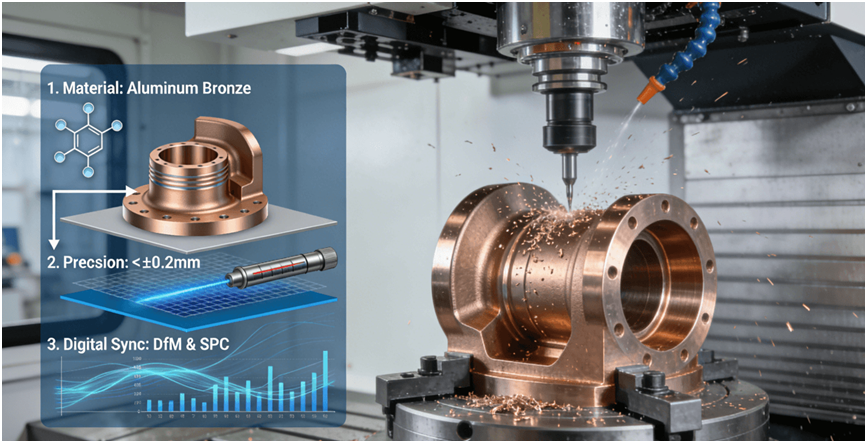
In the competitive field of advanced manufacturing, a common trilemma exists: achieving extreme precision (e.g., ±0.02mm) and fast lead times for complex bronze parts within strict budgets. Traditional methods force compromises, causing delays, cost overruns, or quality issues. This stems from fragmented knowledge of materials, processes, and supply chains. This article outlines a holistic framework integrating materials science, tailored machining strategies, and digital management to systematically overcome this challenge in onlineCNC machining services.
H2: Why is Bronze Still an Indispensable Material in Advanced Manufacturing?
Despite the proliferation of new alloys, bronze remains a cornerstone material for demanding industrial technical applications. Its enduring value lies in a unique combination of properties that are difficult to replicate. Alloys like tin bronze and aluminum bronze offer exceptional wear resistance, excellent corrosion resistance, and beneficial self-lubricating characteristics. These traits make bronze the ideal choice for critical CNC machining parts in aerospace bearings, marine engineering components, and heavy-duty machinery gears, where failure is not an option. Compared to steels, certain bronzes provide superior resistance to seawater and specific chemicals. Versus many aluminum alloys, they offer higher strength and better fatigue resistance at elevated temperatures.
The necessity of bronze in these advanced manufacturing scenarios is underscored by materials science. Research from authoritative institutions, such as the Department of Materials Science & Metallurgy at the University of Cambridge, highlights the fundamental metallurgical reasons behind bronze’s performance, particularly its ability to form protective oxide layers and its favorable microstructure for bearing surfaces. Therefore, for applications prioritizing longevity, reliability, and performance in harsh environments, CNC machining bronze is not just an option but a technical imperative.
H2: What Are the Core Process Challenges in Achieving Micron-Level Precision in Bronze CNC Machining?
Attaining micron-level precision in CNC machining bronze presents distinct advanced manufacturing hurdles that go beyond standard metal cutting. The primary challenges stem from the material’s inherent “gummy” or sticky nature during machining. This characteristic leads to poor chip formation and evacuation, causing built-up edge on cutting tools. The result is increased cutting forces, accelerated tool wear, and compromised surface finish on the final CNC machining parts. Furthermore, the inefficient chip removal and friction generate significant heat. If not meticulously controlled, this heat causes thermal expansion of both the workpiece and the machine tool, directly threatening the achievement of tight tolerance specifications for dimensions, roundness, and flatness.
Traditional machining methods often struggle with these issues, leading to frequent tool changes, extended cycle times, and inconsistent results. Overcoming these challenges demands a sophisticated approach: using sharp, polished cutting tools with specialized geometries and coatings, employing high-pressure coolant systems for effective heat and chip management, and implementing optimized machining parameters (speeds, feeds, depth of cut) specifically calibrated for different bronze alloys. Mastery of these factors is what separates basic machining from precision advanced manufacturing.
H2: How Do Online CNC Machining Platforms Optimize Collaboration Efficiency from Quote to Production?
Modern online CNC machining services revolutionize the traditional procurement workflow through digital integration, bringing unprecedented transparency and efficiency. This transformation is critical for managing custom CNC machining projects successfully.
H3: Digital Transparency and Cost Control
The initial phase is revolutionized by instant, automated quoting systems. Clients upload a 3D model and swiftly obtain a preliminary CNC machining price breakdown. This clarity demystifies all cost factors—material, programming, machine time, and post-processing—enabling informed budgetary decisions and pre-commitment design adjustments.
H3: Early-Stage Design for Manufacturability (DFM)
A core advantage of modern platforms is integrated DFM analysis, transforming initial quotes into collaborative engineering sessions to optimize custom CNC machining.
l Proactive Design Analysis
Upon submission, experienced engineers review the design. They provide feedback on potential issues such as hard-to-machine geometries, unnecessarily tight tolerance calls, or suggestions for design modifications that lower cost and time without compromising functionality.
l Preventing Costly Errors
This front-loaded collaboration in the custom CNC machining workflow is instrumental in avoiding expensive mid-production changes and significantly reducing scrap rates, ensuring a smoother and more predictable manufacturing process.
H3: Streamlined Project Management
Once an order is placed, the platform serves as a centralized hub. Clients can track production status, communicate with the engineering team, and manage revisions in a single, secure interface. This seamless coordination drastically reduces administrative overhead and miscommunication, compressing the overall project timeline from concept to delivery. For a deeper dive into how this integrated approach specifically benefits bronze components, a detailed analysis is offered in this resource: CNC machining bronze.
H2: How to Ensure Processing Consistency for Large-Scale or Complex Parts While Controlling Costs?
For CNC machining manufacturing of high-volume runs or large, intricate components, maintaining consistency is paramount for quality and cost-effectiveness. In industrial technical fields, part-to-part variation is unacceptable. Leading CNC machining services employ a multi-faceted strategy. Statistical Process Control (SPC) is foundational, using real-time data from machining centers to monitor key variables and predict deviations before they result in non-conforming parts. This is complemented by in-process measurement and tool compensation systems that automatically adjust for tool wear or thermal drift. Furthermore, standardized work instructions and rigorous first-article inspection protocols ensure every batch starts correctly. The bedrock of this consistent output is a certified Quality Management System (QMS).
Suppliers holding stringent certifications like IATF 16949 for automotive or AS9100D for aerospace have institutionalized these consistency-driven processes. Their QMS mandates thorough process validation, comprehensive documentation, and continuous improvement cycles, making reliable, high-volume CNC machining manufacturing not an aspiration but a documented standard.
H2: What Key Capabilities Beyond Price Should Be Evaluated When Choosing a Global Manufacturing Partner?
Selecting a partner for custom CNC machining manufacturing requires looking far beyond the initial CNC machining price. A true advanced manufacturing ally brings a suite of capabilities that ensure long-term project success, risk mitigation, and value.
H3: Technical Proficiency and Material Mastery
Evaluation must begin with technical depth. This encompasses a modern equipment portfolio, including multi-axis CNC machines and CMMs, and critically, proven expertise in delivering tight tolerance CNC machining services. Equally vital is profound materials knowledge and application-specific expertise, such as mastering the nuances of machining various bronze alloys, which directly dictates tool life, surface finish, and final part performance in custom CNC machining manufacturing.
H3: Holistic Partner Capabilities Assessment
Beyond technical specs, evaluating a partner’s systemic and collaborative strengths is crucial for long-term project success in advanced manufacturing.
l Certified Quality and Compliance Frameworks
Formal certifications are essential proxies for a systematic quality approach. Standards like ISO 9001, ISO 14001, and industry-specific AS9100D demonstrate a commitment to standardized, auditable processes, providing confidence in consistent compliance with regulatory and customer-specific requirements.
l Project Synergy and Operational Health
Finally, assess vital “soft” capabilities: effective global communication, robust supply chain management for material security, and proven project methodologies. The ability to act as a collaborative engineering partner, offering solutions beyond mere order execution, distinguishes a strategic ally from a simple vendor. As emphasized in industry guidelines, these holistic competencies determine total cost of ownership and project outcomes. A partner like JS Precision embodies this integration of advanced manufacturing technology with deep engineering support.
H2:Conclusion
The journey to excellence in industrial technical and advanced manufacturing is multifaceted. Successfully machining high-performance materials like bronze is no longer a contest of a single process but a comprehensive test of materials science understanding, precision process control, digital collaboration, and an integrated quality management system. The systematic methodology explored herein provides a clear roadmap for manufacturers to navigate the traditional trilemma, finding the optimal balance between precision, speed, and cost to transform reliable designs into high-quality end products.
If your next project involves challenging materials or demanding specifications, it is advisable to engage with a manufacturing expert possessing full certifications and engineering support capabilities at the earliest project stage. Uploading your design files to obtain a detailed quotation with transparent cost structure and process analysis is the definitive first step toward a successful project.
H2:Author Bio
This article was authored by an industrial technical consultant with over a decade of experience in the precision manufacturing sector, specializing in the analysis of advanced manufacturing processes and supply chain optimization. The insights are based on extensive observation and research of the global manufacturing landscape, particularly the ecosystem of online CNC machining services.
H2:FAQs
Q1: What are the most common surface finishes for bronze CNC machined parts?
A: Common treatments include electroless nickel plating for increased hardness and corrosion resistance, and passivation to enhance rust prevention. For applications requiring self-lubrication, the as-machined surface is sometimes retained.
Q2: What is the main challenge in machining large bronze castings, and how is it solved?
A: The primary challenge is distortion due to the release of casting stresses and uneven stock allowance. Solutions include pre-processing like vibration stress relief and employing a “probe-and-cut” strategy to adapt to variable stock conditions.
Q3: What information is typically needed to get an online CNC machining quote?
A: Typically, a 3D model in STEP format, 2D drawings with tolerances and material callouts, required quantity, surface finish specifications, and any specific testing standards (e.g., penetrant testing) are needed.
Q4: How is dimensional stability and roundness ensured for a bronze bearing?
A: A “rough machine – natural aging – finish machine” process route is employed. For the final finishing, sharp, precision boring tools with low, consistent feed rates are used to reliably achieve roundness within 0.005mm.
Q5: What is the typical lead time for a small batch of custom bronze parts?
A: For components of medium complexity, a typical lead time for small-batch production (10-50 pcs) from drawing approval to delivery is 3 to 5 weeks, depending on part complexity and shop floor scheduling.

